
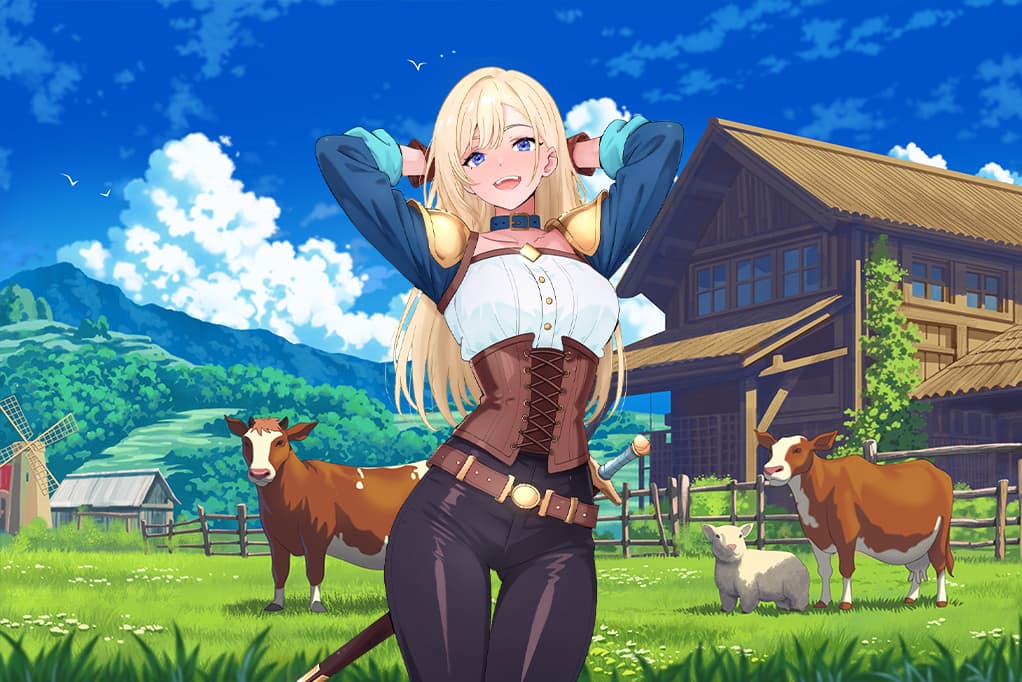
An isekai tabletop RPG is a role-playing game where you play a hero transported or reborn into another world. One participant guides the world as the game master; the others decide what their heroes say and do. Together, you describe scenes and use the game’s rules to resolve uncertain actions.
In Gates of Krystalia, the game master is called the Deux. Each participant, including the Deux, uses a personal 52-card poker deck instead of dice. This guide uses GOK to show how an anime-inspired adventure unfolds: the Deux and the card system are specific to this game.
How to try Gates of Krystalia
- Choose who will be the Deux and guide the world. The other players take the roles of the Heroes.
- Prepare one standard 52-card poker deck for each participant, including the Deux.
- Get the free demo, read it together and follow its instructions to begin playing.
Enter your name and email on the demo page to receive the access link. Choose the download language in the email.
The demo material is available in these six languages:
Italiano · English · Français · Deutsch · Español · Português Brasileiro
From anime to the table: what really changes
In anime or manga, we follow a character’s story. In an isekai RPG, we are responsible for that character’s choices. We do not already know which power they will develop, who will become an ally or what price they will pay to reach a goal.
The Deux presents the world and brings its places, dangers and non-player characters to life. The other participants play the Heroes. The game emerges where the world’s challenges meet the Heroes’ decisions.
The table is not there to reproduce an existing animated series. It creates an anime story that did not exist before the session began.
Rebirth is more than a new appearance
Changing worlds becomes meaningful when it changes how a character understands themself. A Hero may gain extraordinary abilities, but must also learn how to use them and decide what kind of person to become.
In Gates of Krystalia, identity begins with elements such as Race, Class and Innate, then grows through Techniques, Abilities and choices made throughout the campaign. Character creation provides a clear starting point without becoming a cage.
The most important question is not simply “what is my power?” It is “what will I do now that I can truly change things?”
How an isekai story unfolds at the table
Every campaign can have a different pace and tone, but the heart of a session remains simple:
- the Deux presents a situation, place or threat;
- the Heroes state what they want to achieve;
- the rules turn intentions, resources and reactions into consequences;
- the group describes how the story has changed.
A Gate can lead to a fantasy kingdom, a cosmic arena, feudal Japan or a cyberpunk reality. Genre and atmosphere change, while the Hero’s identity remains central across every world.
Everyday moments matter too. Relationships, promises, rivalries, crafting and long-term projects give the campaign continuity. A Hero exists beyond combat.
To make room for a home, relationships and everyday pursuits, explore how to build a slow life campaign in Lumina.
Where the deck comes in
Gates of Krystalia uses no dice. Every participant uses their own standard 52-card poker deck, which represents their Vital Energy. The group does not share one central deck; the Deux also has a personal deck when managing the world and its reactions.
The cards in hand show possibilities that can be spent. Instead of waiting for chance to assign a result, you examine your resources, assess the risk and decide how much the moment deserves.
Played cards become Fatigue. Pushing harder can create a memorable action, but brings a Hero closer to their limit. The full system is explored in Diceless RPGs: how poker cards work.
An example scene
Imagine a Heroine who has just reached a floating city. A leviathan is about to strike the bridge connecting two districts. The scene could become a fight, a rescue or a moral choice: protect the civilians, pursue whoever attracted the creature, or use a powerful Technique immediately and accept its cost.
There is no predetermined sequence. The Deux presents the problem; the people at the table decide which story deserves to emerge from it.
Who might enjoy an isekai RPG
It is an approachable starting point for people who love anime, manga and role-playing video games but have never tried a TTRPG. Rebirth immediately provides direction: cross a threshold, discover the world and build a new identity.
It can also appeal to experienced groups looking for:
- characters who grow with the campaign;
- very different worlds connected by one framework;
- cinematic, reactive combat;
- choices based on visible resources rather than one die roll;
- room for relationships, creation and consequences beyond conflict.
The simplest way to see whether it suits you
A definition helps, but a role-playing game becomes clear when it reaches the table. The shortest route is to play a first mission, look at the cards in your own hand and discover how the group responds to the same situation.
How to start playing Gates of Krystalia explains what each participant needs and the recommended path through the first Gate.
Sources and editorial responsibility
A guide published on the official Gates of Krystalia website. Publisher: Top Notch International LTD.
Rules, examples and narrative suggestions are distinguished in the text. Page references use the Italian edition consulted; translated editions may differ.